
Login or log in?
Login or log in?
If you want to log in then here is the place for (the) login or that’s where you can log in.
Login or log in – What’s the difference.
These are two different words.
Login is a noun and to log in is a verb.
It’s easy to tell them apart. If you, in theory, would need an article before the word or a possessive determiner like his, her, its’, etc, then you must write “login”.
If you need to use “to” like “How do I log in?” then it’s a verb and you have to write “log” and “in” separately. If you need
Like if you forgot your login but you want to log in, then send me an email and we’d set something up so you could log in.
The End:


A few random poems:
- haiku
- Khanaa’s Song by Mallika Sengupta
- Новелла Матвеева – Закон песен
- Midsummer Mobile by Sylvia Plath
- Robert Burns: Lines Sent To Sir John Whiteford, Bart: With The Lament On The Death Of the Earl Of Glencairn
- Miscast II poem – Amy Lowell poems | Poems and Poetry
- In the Matter of One Compass by Rudyard Kipling
- Kindness by Sylvia Plath
- Robert Burns: On Glenriddell’s Fox Breaking His Chain: A Fragment
- Winter Landscape poem – John Betjeman poems
- The Owl And The Lark poem – Alfred Austin
- To a Lady and Her Children by Phillis Wheatley
- Oh Masters
- Lines on Curll poem – Alexander Pope poems | Poetry Monster
- Юнна Мориц – Не вспоминай меня
External links
Bat’s Poetry Page – more poetry by Fledermaus
Talking Writing Monster’s Page –
Batty Writing – the bat’s idle chatter, thoughts, ideas and observations, all original, all fresh
Poems in English
- Robert Burns: The Farewell:
- Robert Burns: Stanzas On Naething: Extempore Epistle to Gavin Hamilton, Esq.
- Robert Burns: Lines Written On A Banknote:
- Robert Burns: Lines To Mr. John Kennedy:
- Robert Burns: Motto Prefixed To The Author’s First Publication:
- Robert Burns: Lines To An Old Sweetheart:
- Robert Burns: The Lass O’ Ballochmyle:
- Robert Burns: Epitaph On “Wee Johnie”: Hic Jacet wee Johnie.
- Robert Burns: Epitaph For Gavin Hamilton, Esq.:
- Robert Burns: Epitaph For Robert Aiken, Esq.:
- Robert Burns: A Bard’s Epitaph:
- Robert Burns: Farewell To Eliza:
- Robert Burns: On A Scotch Bard, Gone To The West Indies:
- Robert Burns: The Farewell To the Brethren of St. James’ Lodge, Tarbolton:
- Robert Burns: Versified Note To Dr. Mackenzie, Mauchline:
- Robert Burns: A Dedication : To Gavin Hamilton, Esq.
- Robert Burns: A Dream: Thoughts, words, and deeds, the Statute blames with reason; But surely Dreams were ne’er indicted Treason. On reading, in the public papers, the Laureate’s Ode, with the other parade of June 4th, 1786, the Author was no sooner dropt asleep, than he imagined himself transported to the Birth-day Levee: and, in his dreaming fancy, made the following Address:
- Robert Burns: Address Of Beelzebub: To the Right Honourable the Earl of Breadalbane, President of the Right Honourable and Honourable the Highland Society, which met on the 23rd of May last at the Shakespeare, Covent Garden, to concert ways and means to frustrate the designs of five hundred Highlanders, who, as the Society were informed by Mr. M’Kenzie of Applecross, were so audacious as to attempt an escape from their lawful lords and masters whose property they were, by emigrating from the lands of Mr. Macdonald of Glengary to the wilds of Canada, in search of that fantastic thing-Liberty.
- Robert Burns: Epistle To A Young Friend:
- Robert Burns: My Highland Lassie, O:
More external links (open in a new tab):
Doska or the Board – write anything
Search engines:
Yandex – the best search engine for searches in Russian (and the best overall image search engine, in any language, anywhere)
Qwant – the best search engine for searches in French, German as well as Romance and Germanic languages.
Ecosia – a search engine that supposedly… plants trees
Duckduckgo – the real alternative and a search engine that actually works. Without much censorship or partisan politics.
Yahoo– yes, it’s still around, amazingly, miraculously, incredibly, but now it seems to be powered by Bing.
Parallel Translations of Poetry
The Poetry Repository – an online library of poems, poetry, verse and poetic works
Log in or Login: What’s the Difference?
The digital revolution has expanded the number of words we need to describe the events and actions of our daily lives. However, as with all growth, some new elements can be confusing. Due to the rapid adoption of password protection as a security feature for hardware and digital services, new terms for these credentials and their use have also come into being.
As you can see from the following chart, log in has seen sporadic use throughout the 19th and 20th centuries. English users have only been shortening the phrase to a single word since roughly the 1980s—coinciding with the widespread adoption of home computing.
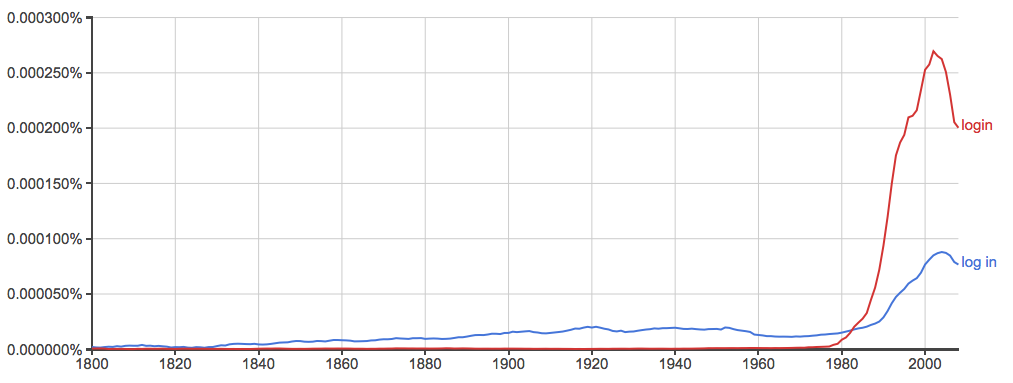
This chart is by no means exact or scientific, since it only counts words from books written in English since 1800. It’s still useful, however, for identifying a long term trend.
Many people aren’t sure whether login or log in is correct when describing these security credentials. Should this term be one word, or two? Since we use it as a noun, a verb, and sometimes as an adjective, the answer depends on context.
What is the Difference Between Log in and Login?
Is login one word? In this article, I will compare log in vs. login, and I will use each in a sentence to illustrate how they are best used. Plus, at the end, I will show you a memory trick to help remember when each term is appropriate.
When to Use Log in
 What does log in mean? If you’re using this term as a verb, separate it into two words. A tech support agent might tell a confused coworker,
- Log in to the computer and adjust the network settings.
-or-
- Log in with your new username and password.
As a verb, log in is broken into two words.
When to Use Login
 What does login mean? When using this term as a noun, shorten it to a single word. Here are some examples:
- Your login is your username and password.
- Do not trust anyone else with your login.
You can also use login as an adjective. Adjectives describe nouns. Here are some sentences where login is used as an adjective:
- Your login information is your username and password.
- You have used 3 of your 5 login attempts.
- And I still haven’t been able to delete my LinkedIn account, since I’ve long forgotten my login credentials and apparently need to send the company a copy of my driver’s license to prove who I am in order to finally deactivate it. –USA Today
As a noun, login is one single word.
Trick to Remember the Difference
If you can’t remember whether log in or login is correct, there is an easy way to remind yourself.
Noun is a single word that ends with an N. So is login. If you keep this fact in mind, it should be easy to remember to use login as a noun.
Summary: Login vs. Log in
Is it login or log in? Log in and login have only seen heavy use since personal computers became ubiquitous in the 1980s, but they are now so common that misusing them in your writing can cost you credibility.
Log in (two words) should only be used as a verb.
Login (one word) can be a noun or an adjective.
Since noun and login are both single words than end in with an N, remembering whether to use login or log in should not be difficult. If you need a refresher on the recent history of these terms or their appropriate usage cases, you can always refer back to this article.