

Login or log in?
Login or log in?
If you want to log in then here is the place for (the) login or that’s where you can log in.
Login or log in – What’s the difference.
These are two different words.
Login is a noun and to log in is a verb.
It’s easy to tell them apart. If you, in theory, would need an article before the word or a possessive determiner like his, her, its’, etc, then you must write “login”.
If you need to use “to” like “How do I log in?” then it’s a verb and you have to write “log” and “in” separately. If you need
Like if you forgot your login but you want to log in, then send me an email and we’d set something up so you could log in.
The End:


A few random poems:
- Gesture Theory A Villanelle
- Epigoni by Neil Outar
- As With A Senryu S Hardening Ridge
- On; On; Poet poem – Aleister Crowley poems | Poetry Monster
- At The Tomb Of Napoleon
- Song For A Summer’s Day by Sylvia Plath
- An Experiment In Translation poem – Alfred Austin
- Море волнуется, манит к себе
- In the Carpenter’s Shop by Sara Teasdale
- Sonet 58 by William Alexander
- The Paper Nautilus by Marianne Moore
- Thoughts Mahomed Akram
- Sing Me A Rainbow by Shel Silverstein
- The Masks of Love
- My Friend, Come In These Rains — English Translation by Rabindranath Tagore
External links
Bat’s Poetry Page – more poetry by Fledermaus
Talking Writing Monster’s Page –
Batty Writing – the bat’s idle chatter, thoughts, ideas and observations, all original, all fresh
Poems in English
- Robert Burns: My Lord A-Hunting:
- Robert Burns: The Bonie Moor-Hen:
- Robert Burns: Prologue: Spoken by Mr. Woods on his benefit-night, Monday, 16th April, 1787
- Robert Burns: Verses Intended To Be Written Below A Noble Earl’s Picture:
- Robert Burns: Epistle To Mrs. Scott: Gudewife of Wauchope-House, Roxburghshire.
- Robert Burns: Inscription For The Headstone Of Fergusson The Poet:
- Robert Burns: Extempore In The Court Of Session:
- Robert Burns: Bonie Dundee:
- Robert Burns: Rattlin’, Roarin’ Willie:
- Robert Burns: Mr. William Smellie -A Sketch:
- Robert Burns: To Miss Logan, With Beattie’s Poems, For A New-Year’s Gift, Jan. 1, 1787:
- Robert Burns: Address To A Haggis:
- Robert Burns: Address To Edinburgh:
- Robert Burns: Yon Wild Mossy Mountains:
- Robert Burns: A Winter Night :
- Robert Burns: On Sensibility: Fragment
- Robert Burns: Epistle To Major Logan:
- Robert Burns: Tam Samson’s Elegy: When this worthy old sportman went out, last muirfowl season, he supposed it was to be, in Ossian’s phrase, “the last of his fields,” and expressed an ardent wish to die and be buried in the muirs. On this hint the author composed his elegy and epitaph.-R.B., 1787.
- Robert Burns: Composed In Spring:
- Robert Burns: Inscribed On A Work Of Hannah More’s: Presented to the Author by a Lady.
More external links (open in a new tab):
Doska or the Board – write anything
Search engines:
Yandex – the best search engine for searches in Russian (and the best overall image search engine, in any language, anywhere)
Qwant – the best search engine for searches in French, German as well as Romance and Germanic languages.
Ecosia – a search engine that supposedly… plants trees
Duckduckgo – the real alternative and a search engine that actually works. Without much censorship or partisan politics.
Yahoo– yes, it’s still around, amazingly, miraculously, incredibly, but now it seems to be powered by Bing.
Parallel Translations of Poetry
The Poetry Repository – an online library of poems, poetry, verse and poetic works
Log in or Login: What’s the Difference?
The digital revolution has expanded the number of words we need to describe the events and actions of our daily lives. However, as with all growth, some new elements can be confusing. Due to the rapid adoption of password protection as a security feature for hardware and digital services, new terms for these credentials and their use have also come into being.
As you can see from the following chart, log in has seen sporadic use throughout the 19th and 20th centuries. English users have only been shortening the phrase to a single word since roughly the 1980s—coinciding with the widespread adoption of home computing.
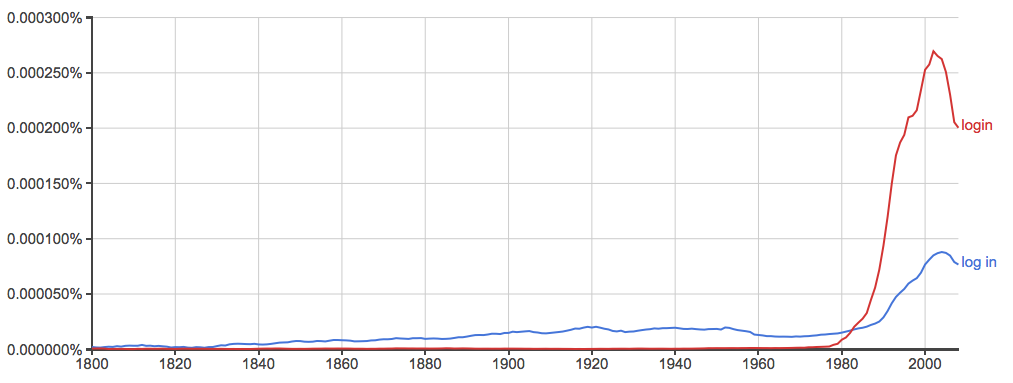
This chart is by no means exact or scientific, since it only counts words from books written in English since 1800. It’s still useful, however, for identifying a long term trend.
Many people aren’t sure whether login or log in is correct when describing these security credentials. Should this term be one word, or two? Since we use it as a noun, a verb, and sometimes as an adjective, the answer depends on context.
What is the Difference Between Log in and Login?
Is login one word? In this article, I will compare log in vs. login, and I will use each in a sentence to illustrate how they are best used. Plus, at the end, I will show you a memory trick to help remember when each term is appropriate.
When to Use Log in
 What does log in mean? If you’re using this term as a verb, separate it into two words. A tech support agent might tell a confused coworker,
- Log in to the computer and adjust the network settings.
-or-
- Log in with your new username and password.
As a verb, log in is broken into two words.
When to Use Login
 What does login mean? When using this term as a noun, shorten it to a single word. Here are some examples:
- Your login is your username and password.
- Do not trust anyone else with your login.
You can also use login as an adjective. Adjectives describe nouns. Here are some sentences where login is used as an adjective:
- Your login information is your username and password.
- You have used 3 of your 5 login attempts.
- And I still haven’t been able to delete my LinkedIn account, since I’ve long forgotten my login credentials and apparently need to send the company a copy of my driver’s license to prove who I am in order to finally deactivate it. –USA Today
As a noun, login is one single word.
Trick to Remember the Difference
If you can’t remember whether log in or login is correct, there is an easy way to remind yourself.
Noun is a single word that ends with an N. So is login. If you keep this fact in mind, it should be easy to remember to use login as a noun.
Summary: Login vs. Log in
Is it login or log in? Log in and login have only seen heavy use since personal computers became ubiquitous in the 1980s, but they are now so common that misusing them in your writing can cost you credibility.
Log in (two words) should only be used as a verb.
Login (one word) can be a noun or an adjective.
Since noun and login are both single words than end in with an N, remembering whether to use login or log in should not be difficult. If you need a refresher on the recent history of these terms or their appropriate usage cases, you can always refer back to this article.