
‘Twas mercy brought me from my Pagan land,
Taught my benighted soul to understand
That there’s a God, that there’s a Saviour too:
Once I redemption neither sought nor knew.
Some view our sable race with scornful eye,
“Their colour is a diabolic die.”
Remember, Christians, Negro’s, black as Cain,
May be refin’d, and join th’ angelic train.
End of the poem
15 random poems
- Василий Лебедев-Кумач – Только на фронте
- ‘Blighters’ by Siegfried Sassoon
- The Singer poem – Alexander Pushkin
- An Early Audience at the Palace of Light. (Harmonizing a poem for Secretary Jia Zhi.) by Wang Wei
- A Mystic As Soldier by Siegfried Sassoon
- Шекспир – Чтобы стихи, рожденные когда-то – Сонет 38
- In a Subway Station by Sara Teasdale
- On the Idle Hill of Summer by A. E. Housman
- Федор Сологуб – Ах, лягушки по дорожке
- Godo Is Not Coming by Ndue Ukaj
- Often I Am Permitted to Return to a Meadow by Robert Duncan
- The Danish Boy by William Wordsworth
- Convalescence poem – Amy Lowell poems | Poems and Poetry
- The Princess (part 7) poem – Lord Alfred Tennyson poems
- The Fisherman by William Butler Yeats
Some external links:
Duckduckgo.com – the alternative in the US
Quant.com – a search engine from France, and also an alternative, at least for Europe
Yandex – the Russian search engine (it’s probably the best search engine for image searches).
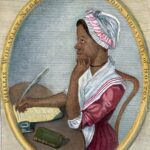
Phillis Wheatley (1753-84), a negro poetess, also an American poet or Afro-American poet, and an English Colonial poet, . She was born in Africa (in Gambia or Senegal) and was aptured by slave traders at the age of eight, she was sold to a family living in Boston, Mass., whose name she bears. While serving as a maid-servant to her proprietor’s wife, she showed an unusual facility with languages. She began writing poetry at the age of thirteen, using as models British poets of the time, especially Alexander Pope and Thomas Gray). In 1773 she accompanied a member of the Wheatley family to England, where she gained widespread attention in literary circles. She subsequently returned to Boston. Her best-known poems are “To the University of Cambridge in New England” (1767), In all honestly Phillis Wheatley should rather be considered English than an Afro-American poet but the exact classification of who she was would depend on the political and cultural views, and biases, of the “classifier.