
A poem by Alexander Pushkin – Pouchkine, Pooshkin (1799-1837), in English translation
_Stanzas from “Onegin”_
Our Northern Winter’s fickle Summer,
Than Southern Winter scarce more bland–
Is undeniably withdrawing
On fleeting footsteps from the land.
Soon will the Autumn dim the heavens,
The light of sunbeams rarer grown–
Already every day is shorter,
While with a smitten hollow tone
The forest drops its shadow leafage;
Upon the fields the mists lie white,
In lusty caravans the wild geese
Now to the milder South take flight;
Seasons of tedium draw near,
Before the door November drear!
From shivering mist ascends the morning,
The bustle, of the fields declines,
The wolf walks now upon the highway,
In wolfish hunger howls and whines;
The traveller’s pony scents him, snorting–
The heedful wanderer breathless takes
His way in haste beyond the mountains!
And though no longer when day breaks
Forth from their stalls the herd begins
To drive the kine,–his noon-day horn recalls.
The peasant maiden sings and spins,
Before her crackling, flaming bright
The pine chips,–friend of Winter night.
And see! The hoar frost colder sparkles
And spreads its silver o’er the fields,
Alas! the golden days are vanished!
Reluctant Nature mournful yields.
The stream with ice all frozen over
Gleams as some fashionable parquet,
And thronging hordes of boyish skaters
Sweep forward on its crystal way.
On her red claws despondent swimming,
The plump goose parts the water cold,
Then on the ice with caution stalking
She slips and tumbles,–ah behold!
Now the first snowflake idling down
Stars the depressing landscape brown.
At such a season in the country,
What can a man’s amusements be?
Walk? And but more of empty highway
And of deserted village see?
Or let him through the far Steppes gallop,
His horse can scarcely stand at all–
His stamping hoofs in vain seek foothold,
The rider dreading lest he fall!
So then remain within thy paling,
Read thou in Pradt or Walter Scott,
Compare thy varying editions,
Drink, and thy scoffing mood spare not!
As the long evenings drag away
So doth the Winter too delay.
FROM “ONEGIN”
Sometimes he read aloud with Olga
A latter day romance discreet,
Whose author truly painted nature,
With cunning plot, insight complete;
Oft he passed over a few pages,
Too bald or tasteless in their art–
And coloring, began on further,
Not to disturb the maiden heart.
Again, they sat for hours together,
With but a chess board to divide;
She with her arms propped on the table,
Deep pondering, puzzled to decide–
Till Lenski from his inward storm
Captured her castle with his pawn!
FROM “ONEGIN”
Love condescends to every altar,
Ah when in hearts of youth it springs,
Its coming brings such glad refreshment
As May rain o’er the pasture flings!
Lifted from passion’s melancholy
The life breaks forth in fairer flower,
The soul receives a new enrichment–
Fruition sweet and full of power.
But when on later altars arid
It downward sweeps, about us flows–
Love leaves behind such deathly traces
As Autumn tempests where it blows
To strip the woods with ruthless hand,
And turn to soggy waste the land!
FROM “ONEGIN”
How sad to me is thine appearing,
O Springtime, hour of love’s unrest!
Within the soul what nameless languors!
What passions hid within the breast!
With what a heavy, heavy spirit
From the earth’s rustic lap I feel
Again the joy of Springtide odors–
That once could make my spirit reel!
No more for me such pleasures thrilling,
All that rejoices, that has life,
All that exults,–brings but despondence
To one past passion as past strife,
All is but prose to such as he,
Wearied unto satiety.
Perchance we fain would pass unnoticed
That which in Autumn drooped and pined,
Now radiant in verdure springing,
Since it must of our loss remind;
As with a tortured soul we realize
In Nature’s glad awakening,
That we shall never find renewal,
Who evermore are withering.
Perchance there haunts us in remembrance,
Our own most dear and lyric dream,
Another long forgotten Springtime–
And trembling neath this pang supreme,
The heart faints for a distant country
And for a night beside the sea!

A few random poems:
- The Jacket by Rudyard Kipling
- What The Thrush Said. Lines From A Letter To John Hamilton Reynolds poem – John Keats poems
- Олег Сердобольский – Задумал слово я такое
- Владимир Британишский – 1942 год
- On The Same Occasion by William Wordsworth
- the_kings_breakfast.html
- the_man_that_poetry_made.html
- Ольга Ермолаева – За Волгой, ударившись озем
- Виктор Гусев – Песня о Москве
- Алексей Толстой – Три побоища
- Rise, O Days. by Walt Whitman
- How Solemn as One by One. by Walt Whitman
- The Empty Hills by Yvor Winters
- Василий Лебедев-Кумач – Так говорил танкистам политрук
- Владимир Корнилов – Зачем
External links
Bat’s Poetry Page – more poetry by Fledermaus
Talking Writing Monster’s Page –
Batty Writing – the bat’s idle chatter, thoughts, ideas and observations, all original, all fresh
Poems in English
- Sonnet 94: They that have power to hurt and will do none by William Shakespeare
- Sonnet 93: So shall I live, supposing thou art true by William Shakespeare
- Sonnet 92: But do thy worst to steal thy self away by William Shakespeare
- Sonnet 91: Some glory in their birth, some in their skill by William Shakespeare
- Sonnet 90: Then hate me when thou wilt; if ever, now by William Shakespeare
- Sonnet 8: Music to hear, why hear’st thou music sadly? by William Shakespeare
- Sonnet 89: Say that thou didst forsake me for some fault by William Shakespeare
- Sonnet 88: When thou shalt be disposed to set me light by William Shakespeare
- Sonnet 87: Farewell! Thou art too dear for my possessing by William Shakespeare
- Sonnet 86: Was it the proud full sail of his great verse by William Shakespeare
- Sonnet 85: My tongue-tied Muse in manners holds her still by William Shakespeare
- Sonnet 84: Who is it that says most, which can say more by William Shakespeare
- Sonnet 83: I never saw that you did painting need by William Shakespeare
- Sonnet 82: I grant thou wert not married to my Muse by William Shakespeare
- Sonnet 81: Or I shall live your epitaph to make by William Shakespeare
- Sonnet 80: O, how I faint when I of you do write by William Shakespeare
- Sonnet 7: Lo, in the orient when the gracious light by William Shakespeare
- Sonnet 79: Whilst I alone did call upon thy aid by William Shakespeare
- Sonnet 78: So oft have I invoked thee for my Muse by William Shakespeare
- Sonnet 77: Thy glass will show thee how thy beauties wear by William Shakespeare
More external links (open in a new tab):
Doska or the Board – write anything
Search engines:
Yandex – the best search engine for searches in Russian (and the best overall image search engine, in any language, anywhere)
Qwant – the best search engine for searches in French, German as well as Romance and Germanic languages.
Ecosia – a search engine that supposedly… plants trees
Duckduckgo – the real alternative and a search engine that actually works. Without much censorship or partisan politics.
Yahoo– yes, it’s still around, amazingly, miraculously, incredibly, but now it seems to be powered by Bing.
Parallel Translations of Poetry
The Poetry Repository – an online library of poems, poetry, verse and poetic works
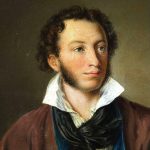
Alexander Pushkin (1799-1937) was a Russian poet, playwright and prose writer, founder of the realistic trend in Russian literature, literary critic and theorist of literature, historian, publicist, journalist; one of the most important cultural figures in Russia in the first third of the 19th century.