
I.
ADIEU, New-England’s smiling meads,
Adieu, the flow’ry plain:
I leave thine op’ning charms, O spring,
And tempt the roaring main.
II.
In vain for me the flow’rets rise,
And boast their gaudy pride,
While here beneath the northern skies
I mourn for health deny’d.
III.
Celestial maid of rosy hue,
O let me feel thy reign!
I languish till thy face I view,
Thy vanish’d joys regain.
IV.
Susanna mourns, nor can I bear
To see the crystal show’r,
Or mark the tender falling tear
At sad departure’s hour;
V.
Not unregarding can I see
Her soul with grief opprest:
But let no sighs, no groans for me,
Steal from her pensive breast.
VI.
In vain the feather’d warblers sing,
In vain the garden blooms,
And on the bosom of the spring
Breathes out her sweet perfumes.
VII.
While for Britannia’s distant shore
We sweep the liquid plain,
And with astonish’d eyes explore
The wide-extended main.
VIII.
Lo! Health appears! celestial dame!
Complacent and serene,
With Hebe’s mantle o’er her Frame,
With soul-delighting mein.
IX.
To mark the vale where London lies
With misty vapours crown’d,
Which cloud Aurora’s thousand dyes,
And veil her charms around.
X.
Why, Phoebus, moves thy car so slow?
So slow thy rising ray?
Give us the famous town to view,
Thou glorious king of day!
XI.
For thee, Britannia, I resign
New-England’s smiling fields;
To view again her charms divine,
What joy the prospect yields!
XII.
But thou! Temptation hence away,
With all thy fatal train,
Nor once seduce my soul away,
By thine enchanting strain.
XIII.
Thrice happy they, whose heav’nly shield
Secures their souls from harms,
And fell Temptation on the field
Of all its pow’r disarms!
End of the poem
15 random poems
- Sonnet 81: Or I shall live your epitaph to make by William Shakespeare
- Waly, Waly poem – Andrew Lang poems
- The Tears of Scotland by Tobias Smollett
- Владимир Маяковский – Птичка божия
- Eclogues by Thomas Chatterton
- After Love by Sara Teasdale
- The Fiddling Wood by Stephen Vincent Benet
- ‘They’ by Siegfried Sassoon
- To a Historian. by Walt Whitman
- the_morning_walk.html
- This Month The Almonds Bloom At Kandahar
- His Confidence by William Butler Yeats
- Mother’s Death 1981 by Michael S Wilson
- Song—A Fiddler in the North by Robert Burns
- Sport
Some external links:
Duckduckgo.com – the alternative in the US
Quant.com – a search engine from France, and also an alternative, at least for Europe
Yandex – the Russian search engine (it’s probably the best search engine for image searches).
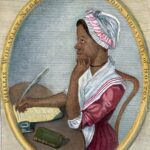
Phillis Wheatley (1753-84), a negro poetess, also an American poet or Afro-American poet, and an English Colonial poet, . She was born in Africa (in Gambia or Senegal) and was aptured by slave traders at the age of eight, she was sold to a family living in Boston, Mass., whose name she bears. While serving as a maid-servant to her proprietor’s wife, she showed an unusual facility with languages. She began writing poetry at the age of thirteen, using as models British poets of the time, especially Alexander Pope and Thomas Gray). In 1773 she accompanied a member of the Wheatley family to England, where she gained widespread attention in literary circles. She subsequently returned to Boston. Her best-known poems are “To the University of Cambridge in New England” (1767), In all honestly Phillis Wheatley should rather be considered English than an Afro-American poet but the exact classification of who she was would depend on the political and cultural views, and biases, of the “classifier.